

The Dutch invented a very specific kind of heartbreak: the best team in the tournament that doesn't win the final. Cruyff's 1974 Netherlands played football from another decade and lost to the hosts anyway. The country still calls them the uncrowned kings, mostly with pride, because in Holland how you play carries a weight the trophy can't fully outrank.
Now look at tomorrow. The dominant team of 2026, six wins for Antonelli, both championships led comfortably, Russell on sprint pole by 0.041, has a very Dutch problem. Mercedes have never won the modern Zandvoort. Not in 2021, 2022 or 2023 while Verstappen made it his garden. Not in 2024 or 2025 while McLaren took over. The works team's only Dutch Grand Prix win is Fangio's, in 1955, by three tenths. Seventy-one years. The team of the season turns up at the one venue that has never once agreed with them, in the last edition there will ever be.
The other lot have Cruyff on their side
Cruyff's most famous line translates as "every disadvantage has its advantage," and I can't think of a purer engineering example than the McLaren gearbox. If you read the gearing piece you know the story. McLaren geared their car to a Mercedes power curve that never shipped, found out too late, and got one chance to fix it: the season's single joker change. In May they said no thanks. Elk nadeel heb z'n voordeel. Last night the disadvantage produced its advantage on live television. Norris was the fastest man on the circuit through the accelerating middle sector, 0.451 clear of the eventual polesitter, and handed nearly all of it back on the two flat-out stretches. The gearbox swing between the two cars came to twelve times the final margin. He also beat Antonelli, the man he's actually chasing, by two tenths.
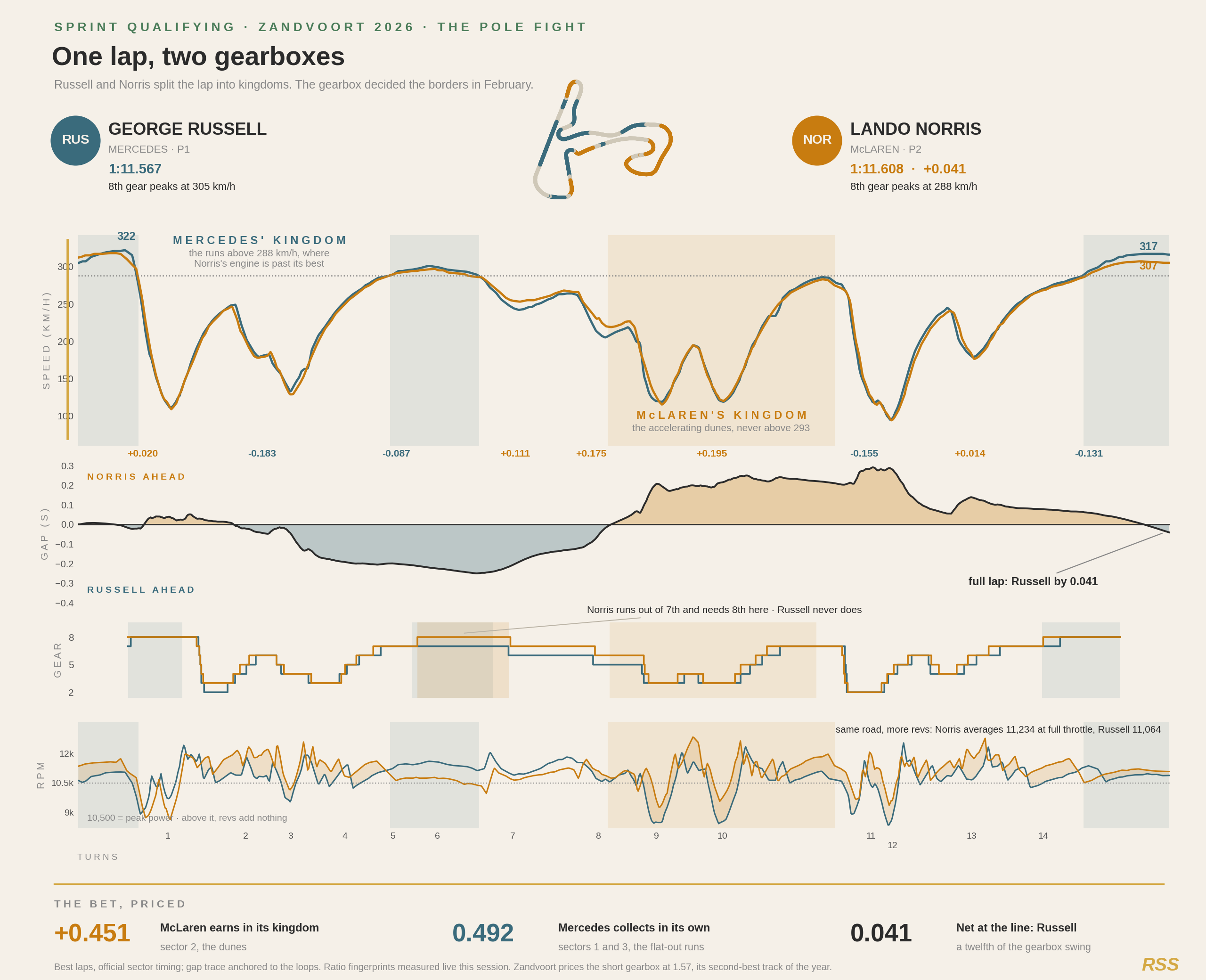
The sprint pole fight was the season's whole argument in one lap. The Mercedes is built like the team: no weak register, revs dropped calmly into the battery, quickest where the track is simplest. The McLaren is built like a gambler, brilliant in one register and taxed in the other, and stuck with the bet until the joker gets played.
What the crown costs from here
This matters beyond one Saturday because of the calendar. I priced McLaren's gearbox at every round this season, the ratio of lap time it earns them under hard acceleration against lap time it taxes them above 288 km/h, where their engine has gone soft. Seven of the last ten measurable rounds favour the short gearbox, some heavily. Singapore prices at 2.66, Austin at 1.90, Bahrain at 1.55. Zandvoort, at 1.57, is the second-friendliest track of the entire year.
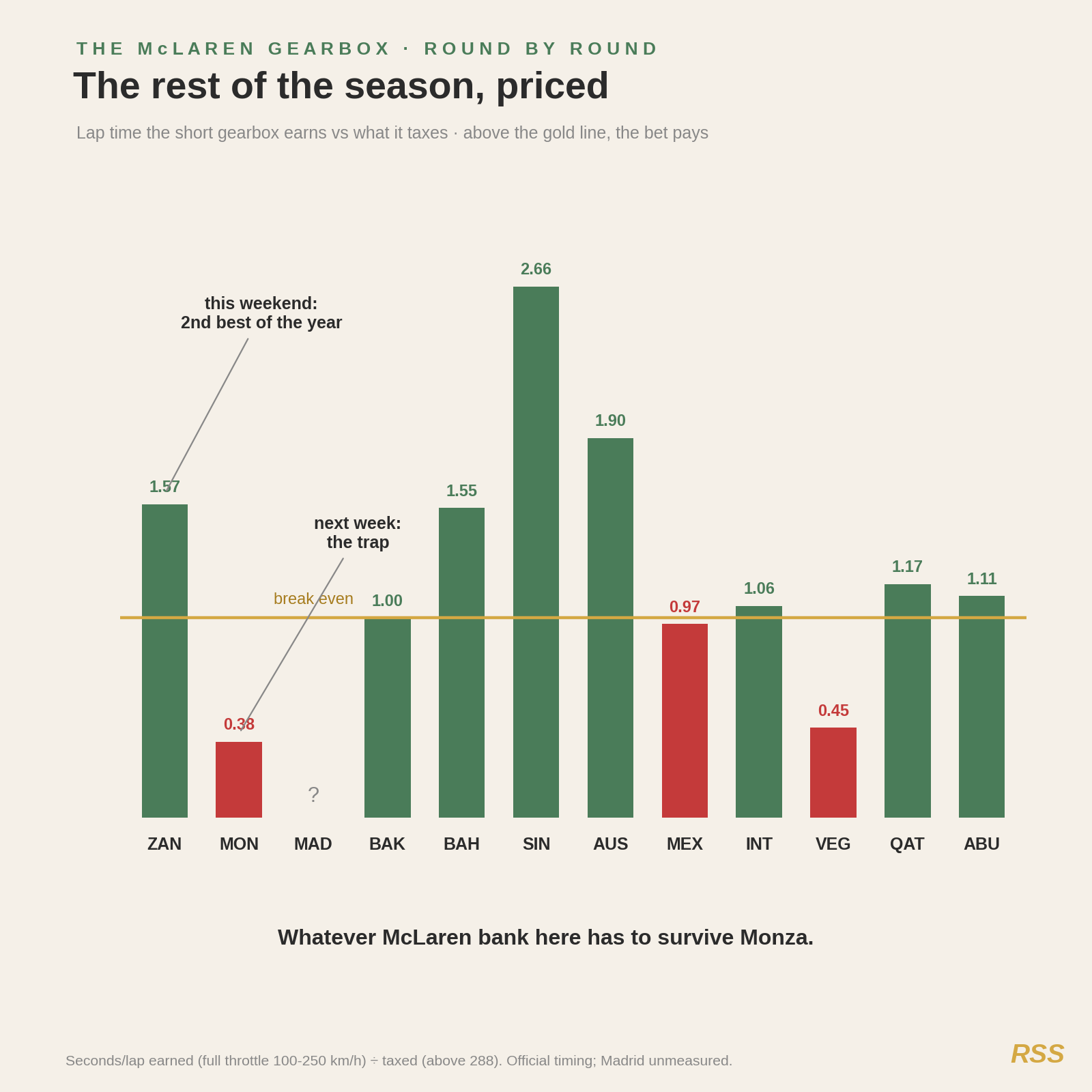
That cuts both ways, and Mercedes should be saying this part out loud: beat McLaren this weekend, at the track their mistake was accidentally built for, and there is no venue left where the gearbox story saves them. The crowning argument is available here in a way it won't be at Monza, where McLaren's number collapses to 0.38 and beating them proves nothing.
And the race runs under a different tax regime from qualifying. One lap on a full battery means nothing to harvest, so McLaren's extra revs under braking cost nothing last night. That's why sprint qualifying was as close as this car gets to a home fixture. Over a race distance the harvest tax comes back, six braking zones a lap, every lap, and Mercedes' long gears bank energy where McLaren's short ones burn it. Sunday leans towards the works team in a way Saturday evening never could.
How sure am I?
A fairness note before anyone points it out: a lap time difference is never one thing. Drag level, downforce choice, deployment modes, driver, tyre phase, they all live inside those sector numbers, and McLaren's rear-end upgrade this weekend deliberately adds drag to buy traction, which pushes in the same directions as the gearing does. For scale, average both cars of each team on official sectors and the whole package earns about three and a half tenths through the dunes, gives three back on the flat-out runs, and nets four hundredths of a second a lap. Read that as the trade at its friendliest, never as a component test. What the data pins down is narrower than the headline and much harder to argue with. The ratios themselves are measured, not inferred: speed per thousand RPM is geometry, and it reads identical on both cars of every team since February. The pattern follows the hardware across teams that share nothing else, because Red Bull, on their own engine and their own aero, geared short and paint the same map on the timing screen. And Williams and Alpine run Mercedes' exact ratios with none of Mercedes' results, which is how you know the remainder of the gap lives in energy software rather than steel. So read the sector numbers as the price of the whole concept the gearbox anchors, short gears plus the wing and the driving that make sense with them, rather than one component in isolation. The direction is certain. The last decimal place is not.
And they've been here before, in the ways that matter. Raw pace was never the guarantee. In 2021 they arrived here leading the championship with a car quick enough for pole, and left beaten. What's missing is getting the weekend right, and this format hands them the map. Sprint: learn, in race conditions, with the tax back on. Qualifying: adjust and tune, because the setup window opens the moment the sprint ends. Sunday: go racing from the front. That last part is everything here, because the winner has come from pole at every single Dutch Grand Prix since the race returned. Five from five. And Mercedes have never taken a Saturday pole at Zandvoort. Verstappen owns three of them, McLaren the other two. Pole converts here like nowhere else on the calendar, and the uncrowned kings have never once held the ticket.
Which leaves them exactly where Cruyff's Netherlands stood. The team with the numbers, needing to prove it on the one afternoon history keeps refusing them. Beautiful season, brilliant car, 71 years of never here, and the final Dutch Grand Prix is, conveniently, a final. Win Saturday afternoon and Sunday is theirs to lose. That is what getting it right means this weekend.
One more thing before you sleep on Sunday's final. The forecast keeps showing rain around Saturday morning, and if it lands, everything in this piece gets suspended while a different piece of physics takes over. Zandvoort's banked corners drain the bowl and hand out cornering force for free (the pre-event deep dive walks the whole circuit), which drags the wet-to-dry crossover forward earlier than any standard pit wall model expects. Teams miss it here for structural reasons, and the ones who catch it steal positions that decide races like tomorrow's. I've written that playbook as its own piece. It publishes in the morning, before the sprint. If you wake up and the sky over the dunes is grey, read it before they form up.
The Verstappen analysis, where his half second actually lives and what Red Bull can legally change overnight, publishes alongside this one.
Pole statistic per Reuters Dutch GP statistics, 19 Aug 2026. Data: official race timing across pre-season testing, Melbourne, and this weekend's sessions; ratio fingerprints verified on both cars of every team. Gear ratio regulations: FIA 2026 Technical Regulations Art. C9.6, as reported by Raceteq and The Race. Dutch GP winners per official records; Mercedes' 1955 win, Fangio, by 0.3s.
Wow not only an engineer, but a phenomenal writer too! I love these Ruth, thank you!